18 min read · Updated May 2026
The Countdown Is On
The 2026 FIFA World Cup opens June 11 (North American Eastern Time) — that's June 12, 3:00 AM in Beijing for the first kick. It's the first tri-nation host cycle and the first 48-team edition, which changes how any serious world cup prediction should be built.
We've pulled together the new rules, all 48 squads, market title odds, contender notes, knockout variables, and the storylines that tend to decide upsets. Think of this as a practical 2026 world cup prediction reference — not a hype sheet.
Tournament at a Glance
- Dates: June 11 – July 19, 2026 (40 days)
- Hosts: United States, Canada, Mexico (16 cities)
- Teams: 48 (first expanded edition)
- Matches: 104 (40 more than Qatar 2022)
- Champion path: 8 games (3 group + 5 knockout)
- Opener: Mexico vs South Africa at Estadio Azteca
- Final: July 19 at MetLife Stadium, New York/New Jersey
New 2026 Format
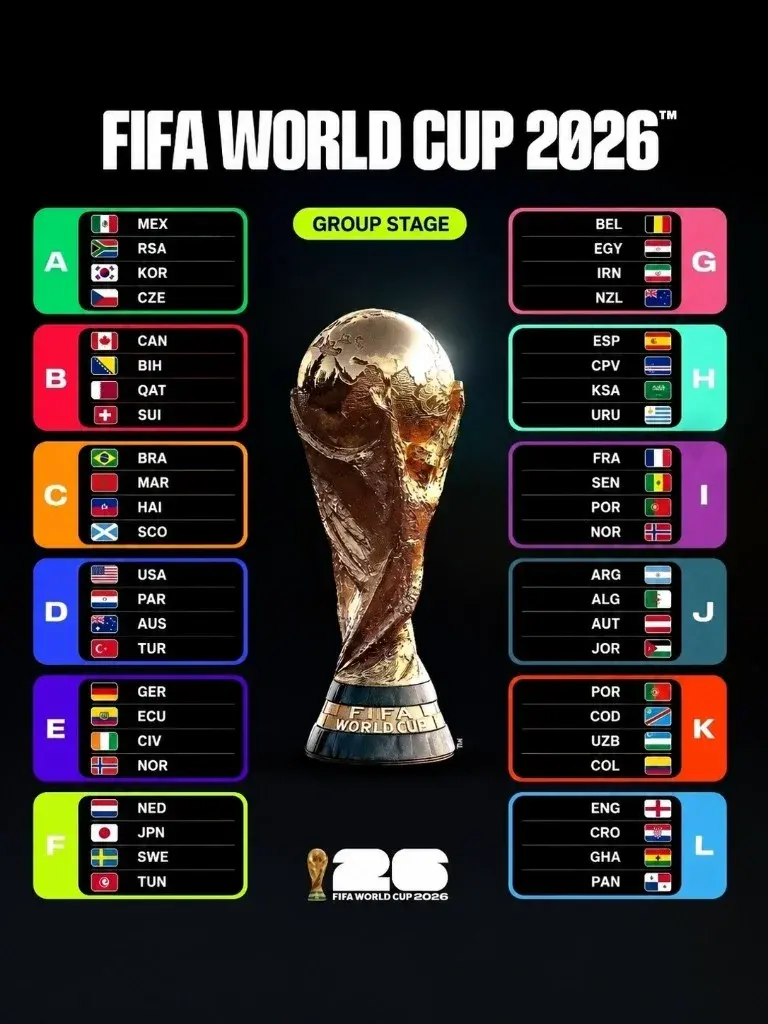
The 2026 world cup prediction landscape starts with the bracket itself: 12 groups of four (A–L), replacing the old 8×4 layout. Qualification and the knockout path were rebuilt from scratch.
Group Stage (Jun 11 – Jun 27)
Round-robin within each group: three matches per team. Win 3 pts, draw 1, loss 0.
- →Top 2 in each group (24 teams) advance directly
- →Best 8 third-place teams also qualify → 32 knockout teams
- →Qualification rate rises from 50% to 67%
- →Tiebreakers: points → goal difference → goals scored → fair play → draw
What This Means for Your Prediction
Favorites get more margin for error — one group loss rarely ends a campaign.
Underdogs and debutants can target third place with around four points (W-D-L).
Final group-round games become tactical calculators for best-third-place spots.
Knockout Stage (Jun 28 – Jul 19)
A new Round of 32 sits before the Round of 16. Every game is single elimination: 90 minutes, 30-minute extra time if tied, then penalties.
- →Round of 32: Jun 28 – Jul 2 (16 games)
- →Round of 16: Jul 4 – Jul 7 (8 games)
- →Quarter-finals: Jul 10 – Jul 11 (4 games)
- →Semi-finals: Jul 14 – Jul 15 (2 games)
- →Third place: Jul 18 · Final: Jul 19
Draw & Seeding
FIFA uses a Grand Slam–style seeding system: Spain, Argentina, France, and England sit in separate halves until the semi-finals.
USA, Canada, and Mexico are automatic top seeds in their groups. Same-confederation teams are kept apart where possible (except UEFA, due to team count).
All 48 Teams
As of April 1, 2026, every berth is confirmed after the intercontinental playoffs. Slots grew across all confederations — Asia leads the headlines with a record nine teams.
- Biggest miss: Italy miss a third straight World Cup
- Surprises: Iraq return after 40 years; Cape Verde, DR Congo, Curaçao, and Haiti debut
- Asia rising: nine teams (+4 vs 2022) — Jordan, Uzbekistan, Iraq back on the global stage
Title Odds & Favorites
Before kickoff, bookmakers and models are already pricing the 2026 title race. Spain lead at 15.4% in most world cup prediction tables — useful context, not a crystal ball.
- 1SpainMarket leader15.4%
- 2EnglandHype watch13%
- 3FranceSolid contender12%
- 4ArgentinaSolid contender11.5%
- 5BrazilSolid contender10.8%
- 6PortugalDark horse7.4%
- 7GermanyOutside shot5.6%
- 8BelgiumOutside shot4.8%
Figures below are illustrative, drawn from public markets and models. They move with squads, injuries, and the draw.
Top Contenders
For any 2026 world cup prediction, the headline names need a second read — form, depth, and how a team handles one-off knockouts matter as much as the odds.
Spain
15.4%The model favorite on possession and passing volume — but controlling the ball still has to become goals in knockout football.
- Why they rate
- Mature tactical identity, strong youth pipeline, and ~65% average possession with ~90% pass completion in recent cycles.
- Risk factor
- High possession without conversion has burned them before — efficiency in the Round of 16 is the real test.
England
13%Second in the odds table, yet the gap between market price and clutch pedigree remains the talking point.
- Why they rate
- Semi-final in 2018, quarter-finals in 2022, Euro 2024 finalists — plus a squad valued north of €1.1B.
- Risk factor
- Penalty shootouts and late knockout collapses (e.g. the 2022 quarter-final miss vs France) keep the 13% figure controversial.
France
12%The most balanced heavyweight: elite attack, solid defensive structure, and fewer injury question marks than most rivals.
- Why they rate
- Mbappé in form, deep midfield, and a roster built for single-elimination pressure.
- Risk factor
- A stacked bracket half could force a Round-of-16 clash with another title contender.
Argentina
11.5%Defending champions navigating life after Messi — with a tighter, more defensive spine than 2022.
- Why they rate
- Improved midfield and defensive metrics; fewer goals conceded, more tackles and interceptions.
- Risk factor
- Attack is less explosive than the Qatar cycle — margins in 90-minute knockouts will be thin.
Brazil
10.8%Still elite on paper, rebuilding around younger attackers as Neymar’s minutes become less reliable.
- Why they rate
- Attack remodel showing results — around 2.1 xG per game in recent windows when the front line clicks.
- Risk factor
- Injury risk and inconsistency in the biggest moments can erase favoritism overnight.
Portugal
7.4%Post-Ronaldo transition done well: young, fast, and tactically flexible — a live upset pick.
- Why they rate
- Average age ~24.7, multiple shape options, and emerging stars like Félix and Gonçalo Ramos.
- Risk factor
- Big-tournament composure is still unproven against the top five in the odds chart.
Data vs The Pitch
Models love possession and squad value; the pitch loves moments. Three patterns from recent tournaments show why a solid world cup prediction mixes numbers with temperament.
Possession ≠ Wins
Spain’s 65% possession and 90% passing look dominant on a spreadsheet, but knockouts reward efficiency — one counter or one penalty shootout ends a control-heavy game plan. Spain lost to Russia in 2018; England fell to France on penalties in 2022.
Market Price vs Clutch DNA
England’s stable scoring and defensive numbers support a high price, yet knockout history tells another story. A strong group stage can inflate odds that do not survive 120 minutes and spot-kicks.
France, Brazil & Argentina: Steadier Profiles
France combine shot volume with defensive discipline; Brazil’s attack remodel is producing chances; Argentina trade some flair for structure. None are guaranteed — but their risk profiles look more balanced than pure hype plays.
Knockout Variables
From the Round of 32 onward, one bad night ends a campaign — no matter how strong the group stage looked.
- Draw luck: a France vs Argentina or Brazil vs Germany tie in the Round of 16 can eliminate a pre-tournament favorite.
- Squad rotation: Spain, Portugal, England, France, and Brazil all have usable depth — injuries hurt less until the quarter-finals.
- Single-elimination chaos: Germany’s 2022 group-stage exit proved even elite brands can be gone in a week.
- Third-place math: the new format means group-stage points and goal difference still shape who you meet first in knockouts.
Upsets are routine at a World Cup. Treat the numbers as a starting line — the pitch decides the rest.
Must-Watch Storylines
- Last dance vs new kings: Messi, Ronaldo, Modrić — versus Mbappé, Haaland, Bellingham, Musiala
- Expansion chaos: more nations, more upsets, more knockout surprises
- Asia's ceiling: can anyone beat Japan's 2022 Round of 16 and push for a quarter-final?
- Tri-nation experience: three cultures, one tournament — Azteca hosts its third World Cup
- Best-third-place drama: every group game matters until the final whistle of the group stage